 TARS
Chronotype quiz Early bird, night owl or in between?
Your chronotype is the time of day your body prefers to sleep and wake. Answer 8 questions and get your type, a suggested sleep window and a wake time to set as your alarm. Free, no sign-up.
- 8 questions
- 1 minute
- free
- Sleep window--
- Wake time--
- Sharpest hours--
Your chronotype
TARS: Talking AI Alarm Clock
Free on the App Store, for iPhone
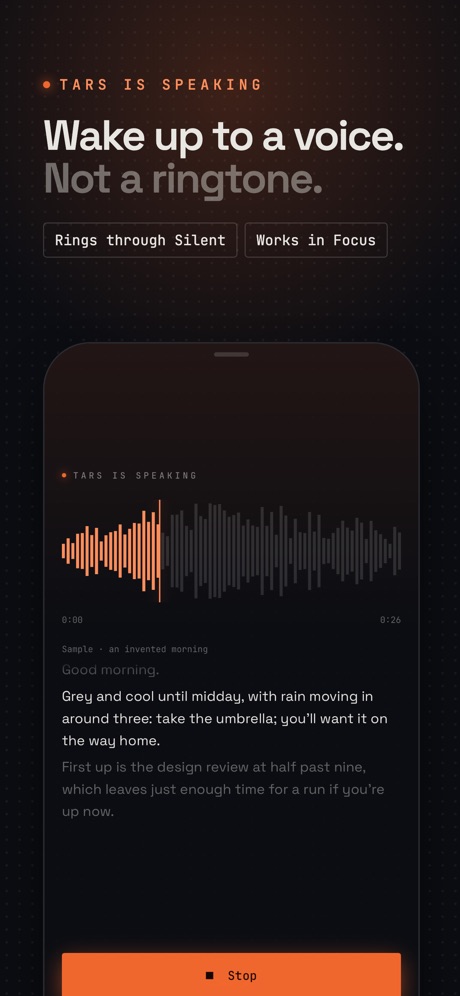
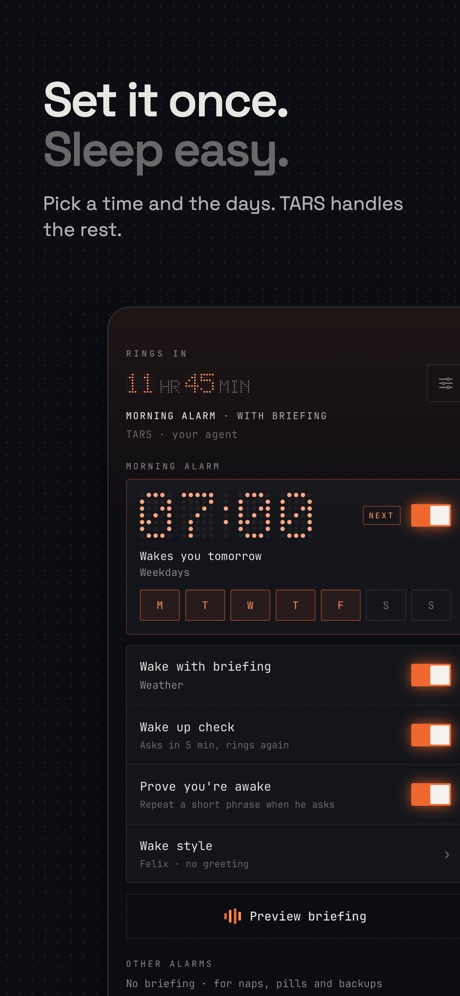
Your wake time is {time}. Set it once in TARS and it rings even on Silent.
- Set your wake time and days once
- Rings on Silent and in Focus
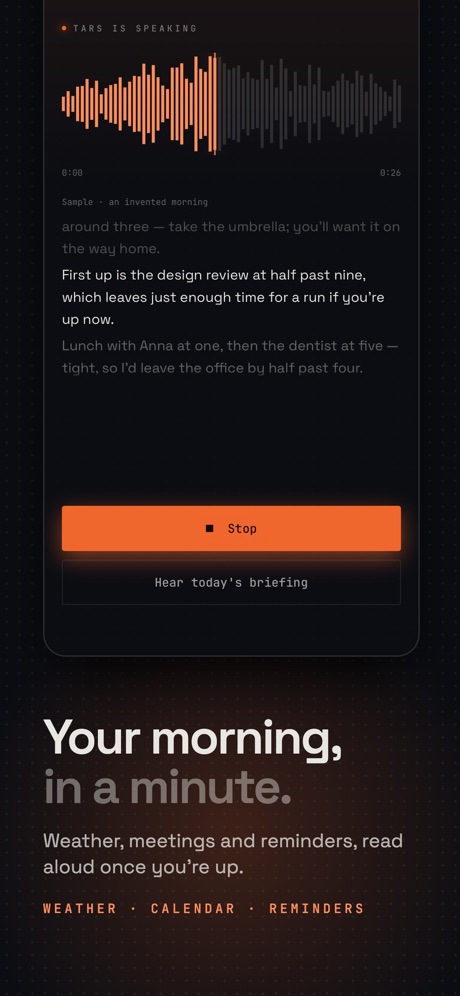
- Reads your weather and calendar aloud

 On a computer?
Scan with your iPhone.
The three types
- Early birdup at 6:00 amYou
- In-betweenup at 7:00 amYou
- Night owlup at 8:30 amYou
Your day
This is a self-check, not a medical test. It sorts you into one of three broad groups and does not measure your body clock. Your answers were scored in this browser and were not sent anywhere.
Updated · by the TARS team, I12Y LTD
How the quiz works
Each answer gives 0 to 4 points. Answers that point to mornings give more. The points add up to a number from 0 to 28, and that number puts you in one of three types.
| Type | Points | Suggested sleep window | Wake time |
|---|---|---|---|
| Early bird | 20 to 28 | 10:00 pm to 6:00 am | 6:00 am |
| In-between | 12 to 19 | 11:00 pm to 7:00 am | 7:00 am |
| Night owl | 0 to 11 | 12:30 am to 8:30 am | 8:30 am |
The window is 8 hours long, inside the 7 to 9 hours the NHS gives as the adult average. If you have to be up at another hour, type it into the result and the window moves with it. Your sharpest hours are your own answer to question 4.
What the types mean
- Early birdup at 6:00 amYou
- In-betweenup at 7:00 amYou
- Night owlup at 8:30 amYou
- Early bird 20 to 28 points
- Up with the birds. Your best hours come before lunch, and by late evening you are running on fumes.
- In-between 12 to 19 points
- Neither lark nor owl. You are in the big middle with most people, and an hour either way will not break you.
- Night owl 0 to 11 points
- Your day starts late and peaks late. You and the 7 am alarm were never friends, and you pay back the lost sleep on days off.
Where this comes from
Sorting people into morning, evening and intermediate types by a short questionnaire goes back to Horne and Östberg, 1976. Their morning types went to bed and got up earlier than evening types. The questions and cut-offs on this page are our own. This is not their questionnaire and not a clinical tool.
Most people fall between the two extremes, and chronotype depends on age and sex. Late types sleep least on work nights and catch up on free days. Researchers named that gap social jetlag.
What helps each type
Early bird
- Put your hardest work in the hours you picked in question 4. For most early birds that is before lunch.
- Plan late evenings on purpose. You will be tired before everyone else, so leave room to sleep in the next day or keep the night short.
- Keep the same wake time on weekends. It is the first item on the AASM list of sleep habits.
In-between
- Pick one wake time and keep it all week, weekends included. You can hold a schedule that early and late types struggle with.
- Set a bedtime that leaves at least 7 hours before that alarm.
- If your mornings feel heavy anyway, look at how long you sleep before you blame your type.
Night owl
- On work nights you are the type that sleeps least. Count back 7 to 8 hours from your alarm and treat that as a real appointment.
- Dim the lights and put screens away in the evening. The AASM list says to limit bright light in the evening and switch devices off 30 minutes before bed.
- Sleep in on days off by an hour at most. The bigger the gap between work days and free days, the harder Monday gets.
Questions people ask
What is a chronotype?
The time of day your body prefers to sleep and be awake. Early types wake and tire early, late types do the opposite, and most people sit in between.
How accurate is a chronotype quiz?
It is a self-report, like the morningness questionnaires researchers have used since 1976. It sorts you into one of three broad groups. It does not measure your body clock.
Can my chronotype change?
Yes. Research on tens of thousands of people shows that chronotype depends on age and sex, so the type you have at 20 is not fixed for life.
What if my job does not fit my chronotype?
Keep one wake time all week and move your bedtime to match it. Sleeping far later on days off makes the work week harder.
Is this the lion, bear, wolf and dolphin quiz?
No. Those four animals are Michael Breus's own scheme. Roughly, his lion is our early bird, his bear is in-between and his wolf is the night owl. His dolphin describes light, restless sleepers, which this quiz does not measure.
Am I a morning person or a night owl?
If you wake up on your own before 7 on free days and feel sleepy by 10 pm, you lean morning. If you would sleep past 10 am and feel sharp late at night, you lean evening. The quiz puts a number on it.
Sources
- Horne J. A., Östberg O., A self-assessment questionnaire to determine morningness-eveningness in human circadian rhythms. International Journal of Chronobiology, 1976.
- Roenneberg T. and others, Epidemiology of the human circadian clock. Sleep Medicine Reviews, 2007.
- Wittmann M. and others, Social jetlag: misalignment of biological and social time. Chronobiology International, 2006.
- American Academy of Sleep Medicine, Healthy Sleep Habits.
- NHS, Insomnia. How much sleep adults need.