 TARS
Sleep quality test How good is your sleep, from 0 to 100?
Answer 12 questions about your last two weeks and get a sleep score from 0 to 100, split into four parts: falling asleep, staying asleep, your morning and your rhythm. It takes two minutes. No sign-up, and your answers stay in your browser.
- 12 questions
- 2 minutes
- free
- Falling asleep--
- Staying asleep--
- Morning--
- Rhythm--
Your sleep score
Worth a doctor's visitTalk to a doctor about this. Loud snoring with pauses in breathing, or dozing off most days, needs a proper check, and a quiz cannot do that. The NHS lists breathing that stops and starts in sleep and constant daytime tiredness as reasons to see a GP.Talk to a doctor about this. NHS: signs of sleep apnoea
TARS: Talking AI Alarm Clock
Free on the App Store, for iPhone
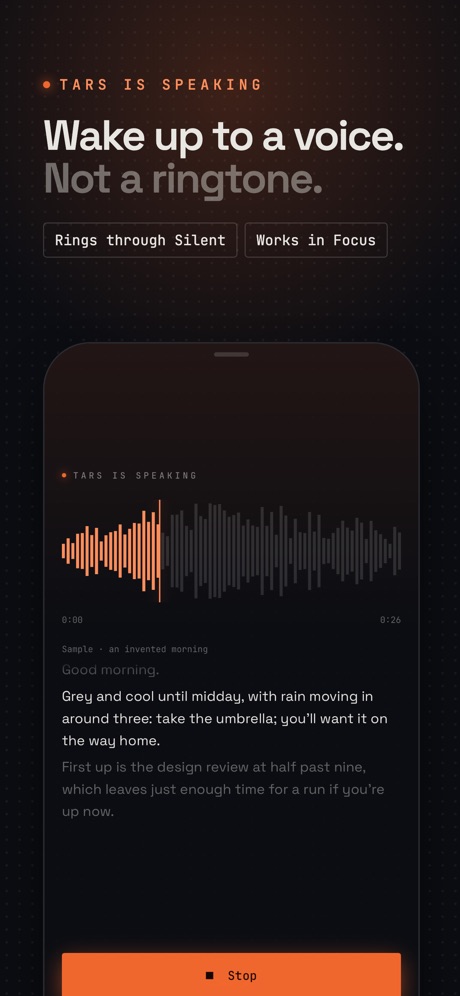
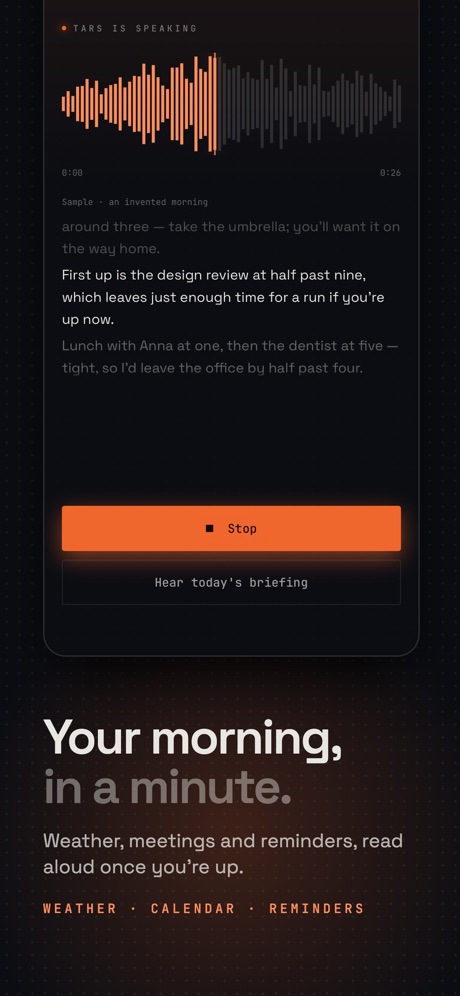
Mornings are your weakest part. TARS wakes you with a voice and reads you your day.
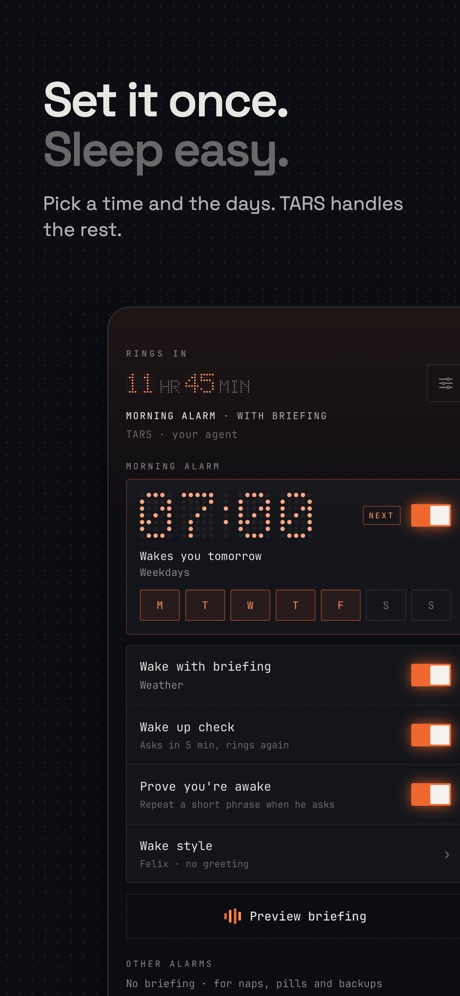
Rhythm starts with one wake time. TARS rings at yours, even on Silent.
TARS is an alarm, so it can't fix your nights. It keeps your wake time steady.
Your sleep is in good shape. TARS can make waking up as good as the night.
- Rings on Silent and in Focus
- Reads your weather and calendar aloud
- Free alarm, no account, no ads

 On a computer?
Scan with your iPhone.
The four parts
This is a self-check. It is not a medical test or a diagnosis. Your answers were scored in this browser and were not sent anywhere.
Updated · by the TARS team, I12Y LTD
How the score is calculated
Each of the 12 questions gives 0 to 3 points. More points mean worse sleep. The sleep score is 100 × (1 − points ÷ 36), rounded to a whole number. Zero points is a score of 100. All 36 points is a score of 0.
The same formula runs on four groups of three questions, so you can see which part of your sleep pulls the number down.
| Part | Questions | What it covers |
|---|---|---|
| Falling asleep | 2, 11, 12 | Time to fall asleep, caffeine after 2 pm, phone in bed |
| Staying asleep | 3, 4, 5 | Wake-ups in the night, time awake in the night, waking too early |
| Morning | 6, 7, 8 | How rested you feel, time to feel fully awake, snooze count |
| Rhythm | 1, 9, 10 | Hours of sleep, weekend shift, dozing off in the day |
Question 13, about snoring and pauses in breathing, is not scored. A "yes" there, or dozing off most days in question 10, adds a line that tells you to talk to a doctor.
What the levels mean
- Good 80 to 100
- Most of your answers sit in the range sleep researchers call good quality. Keep your wake time steady and leave the rest alone.
- Fair 60 to 79
- Mostly fine, with a leak or two. Fix the weakest part first and the number moves.
- Poor 40 to 59
- Your sleep is costing you something on most days. The four parts show where it goes wrong.
- Very poor 0 to 39
- A rough two weeks. If it has been like this for months, see a doctor. The NHS advice is the same.
Where the cut-offs come from
Zero points in questions 2, 3 and 4 match the National Sleep Foundation checklist for adults aged 18 to 64: asleep in 30 minutes or less, awake once or not at all, awake for 20 minutes or less in total. The checklist comes from a 2017 expert panel report in the journal Sleep Health. The 7 to 9 hours in question 1 is the NHS average for adults.
The other cut-offs (snooze count, weekend shift, caffeine after 2 pm, phone in bed) are our own scale. We built it on the sleep habit lists of the American Academy of Sleep Medicine and the NHS. They are not clinical thresholds, and people aged 65 and over have slightly looser targets on the same checklist.
What to do, part by part
The result shows three steps for your weakest part. Here are all of them.
Falling asleep
- Have your last coffee or tea at least 6 hours before bed. In a 2013 study, caffeine taken 6 hours before bedtime still disrupted sleep.
- Put your phone away 30 minutes before you want to be asleep. That is the number on the AASM list of sleep habits.
- Go to bed when you are sleepy. If you are still awake after about 20 minutes, get up and do something quiet in low light, then try again.
Staying asleep
- Make the bedroom dark, quiet and cool. Curtains, an eye mask or ear plugs all count.
- Skip alcohol and big meals late in the evening, and drink less of anything before bed. Both the AASM and the NHS list these.
- After a bad night, get up at your usual time anyway. The NHS advice is to stick to your regular hours and skip the lie-in.
Morning
- Give your head 15 to 30 minutes. The foggy stretch after waking is called sleep inertia, and most of it clears in that time.
- The fog is heavier after a short night. A bad morning is often fixed the evening before, with an earlier bedtime.
- A short snooze is fine. In a lab study of habitual snoozers, 30 minutes of it cost about 6 minutes of sleep and did not hurt test results. The same study found that people who snooze tend to sleep less, so look at your bedtime first.
Rhythm
- Get up at the same time every day, weekends included. It is the first item on the AASM list.
- Set a bedtime that leaves room for at least 7 hours. Adults need 7 to 9 on average.
- If you doze off during the day without meaning to, tell a doctor about it.
If no part is weak
- Keep your wake time the same every day, weekends included. Both the AASM and the NHS put it on their lists.
- Come back after your schedule changes, like a new job or a move across time zones, and compare the two scores.
Questions people ask
What is a good sleep score?
80 or above on this test. In practice that means you fall asleep within 30 minutes, wake up once or not at all and feel rested most mornings.
How is the score calculated?
Each answer gives 0 to 3 points, and more points mean worse sleep. The points are added up and turned into a 0 to 100 scale. The full table is on this page.
Is this the Pittsburgh Sleep Quality Index?
No. This is a short self-check that uses the National Sleep Foundation's sleep quality indicators for adults. It is not a clinical questionnaire.
Can a quiz tell me if I have insomnia or sleep apnea?
No. If you doze off during the day or someone hears you stop breathing at night, see a doctor.
How can I raise my score?
Start with the weakest of the four parts. The result shows which one it is and gives three things to try.
Are my answers stored?
No. The score is calculated in your browser. Your answers are not sent to a server, and there is no sign-up.
Sources
- National Sleep Foundation, What Is Sleep Quality? Checklist for adults: asleep in 30 minutes or less, one wake-up or fewer, 20 minutes or less awake in the night.
- Ohayon M. and others, National Sleep Foundation's sleep quality recommendations: first report. Sleep Health, 2017.
- NHS, Insomnia. How much sleep adults need, sleep habits, when to see a GP.
- NHS, Sleep apnoea. Symptoms and when to see a GP.
- American Academy of Sleep Medicine, Healthy Sleep Habits.
- Drake C. and others, Caffeine effects on sleep taken 0, 3, or 6 hours before going to bed. Journal of Clinical Sleep Medicine, 2013.
- Sundelin T., Landry S., Axelsson J., Is snoozing losing? Journal of Sleep Research, 2024 (online 2023).
- Hilditch C. J., McHill A. W., Sleep inertia: current insights. Nature and Science of Sleep, 2019.