 TARS
Alarm calculator How many alarms should I set?
One, say sleep specialists. Answer 4 questions about your alarms and your snooze habit and see how many minutes of sleep they cut into pieces every morning. You also get a two-week plan to go from five alarms, or however many you set, down to one. Free, no sign-up.
- 4 questions
- 30 seconds
- free
- Between alarms--
- Snoozing--
- Per week--
Broken sleep per morning

TARS: Talking AI Alarm Clock
Free on the App Store, for iPhone
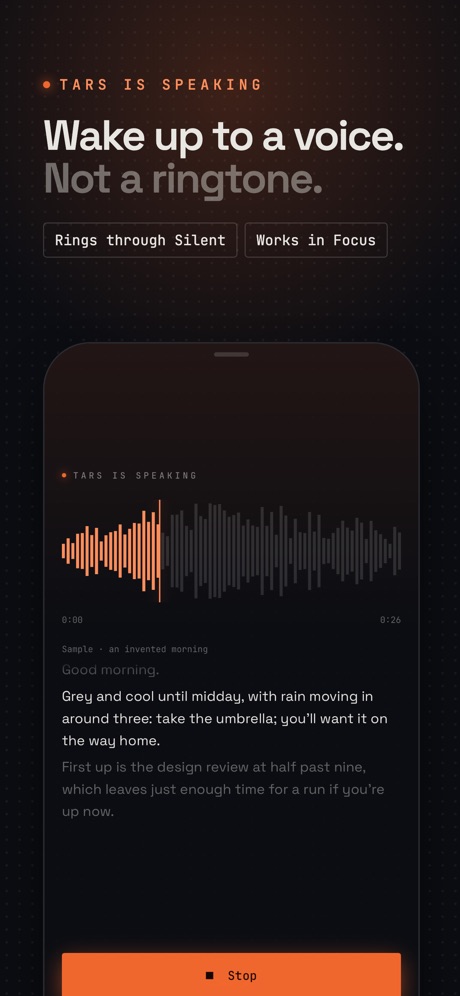
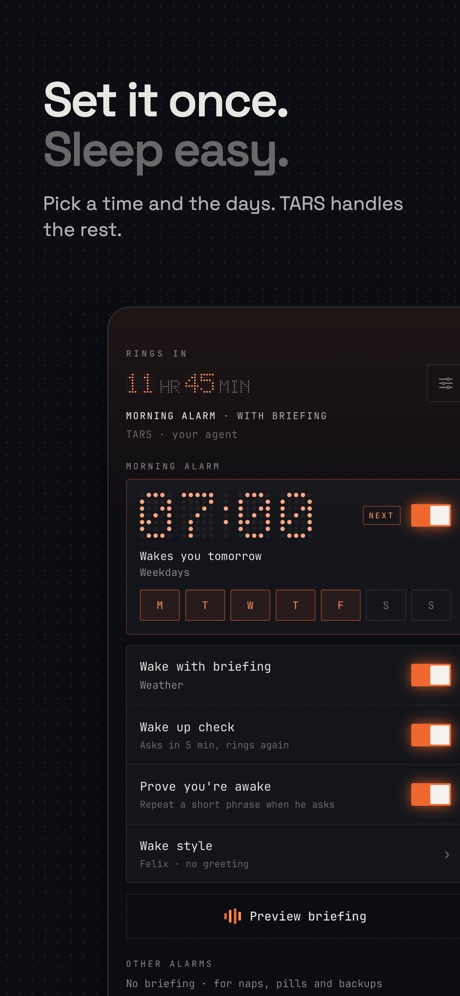
The plan ends at one alarm. TARS is built to be that one: no snooze button, and it rings on Silent.
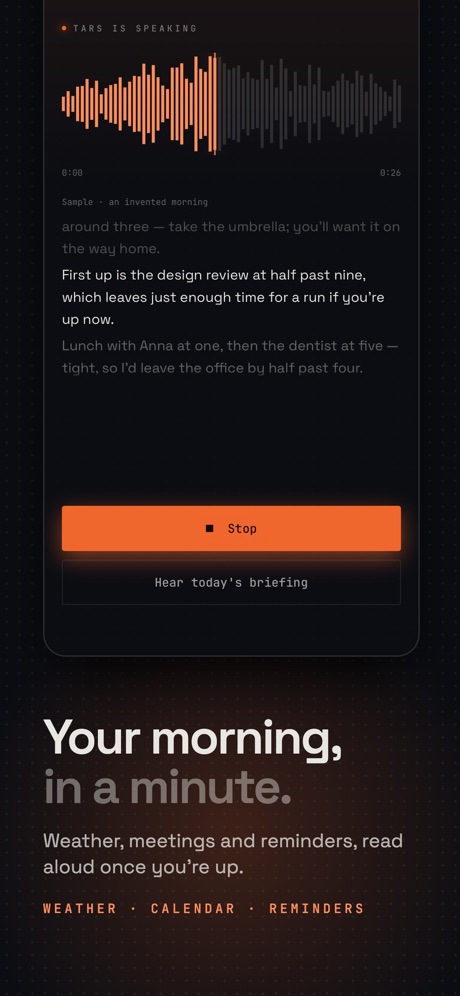
You already wake up on one alarm. TARS makes that one talk: weather, calendar, reminders.
- No snooze. It wakes you with a spoken question
- Rings on Silent and in Focus
- Free alarm, no account, no ads

 On a computer?
Scan with your iPhone.
Where the minutes come from
This is arithmetic, not a medical test. Broken sleep is not the same as lost sleep, and the number is an upper estimate. Your answers stayed in this browser.
Updated · by the TARS team, I12Y LTD
The short answer: one
"My general advice is that you set one alarm. The more alarms you have, the harder it's going to be for you to wake up in the morning," says Alicia Roth, PhD, sleep psychologist at Cleveland Clinic. Her other points: set the alarm for the time you really have to get up, and if you are used to several alarms, it is fine to work your way down to one slowly.
How the calculator counts
From your first alarm to the moment you get up, your sleep is interrupted every few minutes. The calculator adds up that stretch: (alarms − 1) × minutes between them + snoozes × snooze length.
Example: five alarms 10 minutes apart, then two snoozes of 9 minutes. That is (5 − 1) × 10 + 2 × 9 = 58 minutes of sleep in pieces every morning, or 4 hours 50 minutes over a five-day week.
Broken is not the same as lost. In a lab study of habitual snoozers, 30 minutes of snoozing cost about 6 minutes of sleep and did not hurt test results. What you get in that stretch is light, interrupted sleep, so read the number as an upper estimate.
What the levels mean
- Chopped up 31 minutes or more
- Your alarms start the party long before you get up. More than half an hour of sleep arrives in slices. If an earlier bedtime does not help, mention it to a doctor.
- Sliced 16 to 30 minutes
- You wake up several times to get up once. Up to half an hour of your sleep comes in slices every morning.
- Nibbled 1 to 15 minutes
- A small safety net. Your alarms nibble at the last minutes of the night, and those are easy to win back.
- One and done 0 minutes
- One alarm, no snooze, up you get. This is the setup sleep specialists recommend. Nothing to cut.
From five alarms to one in two weeks
The calculator builds this plan from your own numbers. Here it is for five alarms and a snooze habit. The rule is simple: every few days, delete the earliest alarm. The last one stays where it is, because that is when you really get up.
- 14
- 24
- 34
- 43
- 53
- 63
- 72
- 82
- 91
- 101
- 111
- 121
- 131
- 141
- Days 1 to 3: 4 alarms. Delete the earliest one and leave the rest where they are.
- Days 4 to 6: 3 alarms. Delete the earliest one and leave the rest where they are.
- Days 7 to 8: 2 alarms. Delete the earliest one and leave the rest where they are.
- Days 9 to 11: one alarm, set for the time you really get up. Snooze is still allowed.
- Days 12 to 14: one alarm, no snooze. Put the phone where you have to stand up to reach it.
Two things make the plan stick, both from the same Cleveland Clinic advice: an alarm you have to get out of bed to switch off, and the same sleep schedule on weekends as on weekdays.
If you already use one alarm
- Keep the alarm at the time you really get up.
- Keep the same wake time on weekends. Late weekends make Monday hard, and that is when the extra alarms come back.
What the research says about many alarms
A 2022 study of 450 adults counted using several alarms as snoozing. 57% of the people in it snoozed. Snoozers had lighter sleep before waking and a higher resting heart rate. They did not sleep less than people who got up at the first alarm.
So the evidence is mixed: a few minutes of snooze is not proven harmful, and a long string of alarms means your last half hour or more is light sleep in pieces. If you cannot get up without that string, the cause is usually a short night or a late body clock.
Questions people ask
How many alarms should I set to wake up?
One, set for the time you really have to get up. That is the advice of Cleveland Clinic sleep psychologist Alicia Roth: the more alarms you have, the harder it gets to wake up.
Is it bad to set multiple alarms?
Each extra alarm wakes you a little, so the last stretch of your night comes in pieces. In a 2022 study, people who snoozed had lighter sleep before waking.
How far apart should I set my alarms?
If you keep more than one for now, the gap matters less than the count. Every gap is interrupted sleep. Delete the earliest alarm first and keep the last one.
Is hitting snooze bad?
A short snooze is not proven harmful. In a lab study, 30 minutes of snoozing cost about 6 minutes of sleep and did not hurt test results. Many rounds every morning usually mean the night was too short.
How do I get down to one alarm?
Slowly. Delete the earliest alarm every few days and keep the last one at the time you really get up. The calculator gives you the days.
Why do I sleep through my alarms?
Often it is a short night or a late body clock. If it keeps happening and affects your days, see a doctor or a sleep specialist.
Sources
- Cleveland Clinic Newsroom, Sleep Expert Weighs in on Ideal Number of Alarms. September 6, 2024.
- Sundelin T., Landry S., Axelsson J., Is snoozing losing? Journal of Sleep Research, 2024 (online 2023).
- Mattingly S. M. and others, Snoozing: an examination of a common method of waking. Sleep, 2022.