 TARS
Sleep need quiz How much sleep do I need?
Adults are told to sleep 7 to 9 hours, and that leaves a two-hour gap. Answer 8 questions about your nights and mornings and see where you probably sit inside it, on a scale of hours. You also get a lights-out time for the hour you have to be up. Free, no sign-up.
- 8 questions
- 1 minute
- free
- Your range--
- Recommended at your age--
- Lights out--
You probably need

TARS: Talking AI Alarm Clock
Free on the App Store, for iPhone
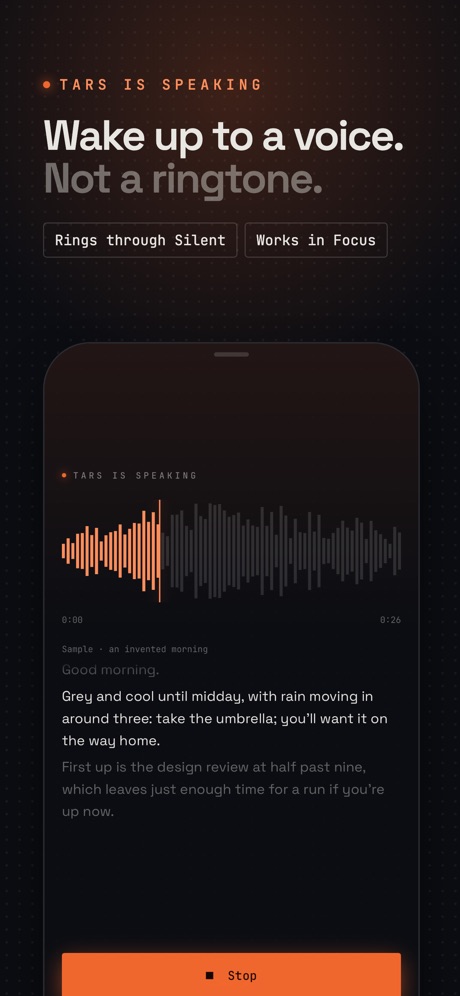
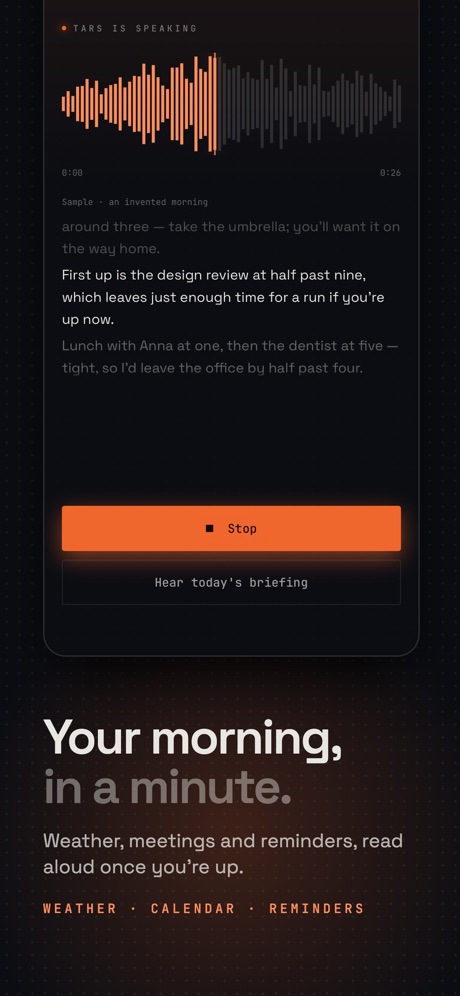
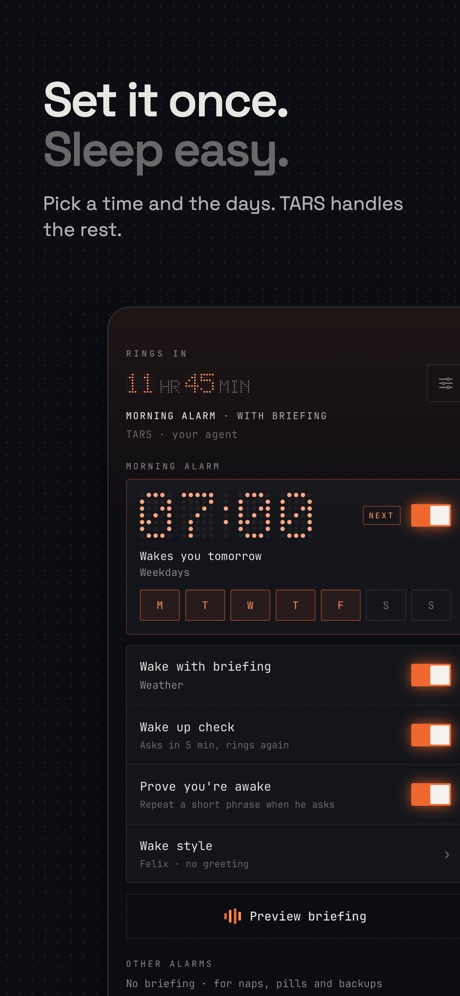
Up at {time}? Make that your TARS alarm. It rings even when your iPhone is on Silent.
- It wakes you with a spoken question
- Rings on Silent and in Focus
- Free alarm, no account, no ads

 On a computer?
Scan with your iPhone.
Your numbers
A rule of thumb from 8 answers. It cannot measure your sleep and it is no medical test. If you nod off during the day or snore with pauses in your breathing, talk to a doctor. Your answers stayed in this browser.
Updated · by the TARS team, I12Y LTD
The short answer, by age
"Adults should sleep 7 or more hours per night on a regular basis to promote optimal health." That is the joint position of the American Academy of Sleep Medicine and the Sleep Research Society. The US National Heart, Lung, and Blood Institute puts it as a range: "Experts recommend that adults sleep between 7 and 9 hours a night."
| Age | Hours per 24 hours | Who says so |
|---|---|---|
| 4 to 12 months | 12 to 16, naps included | AASM, NHLBI |
| 1 to 2 years | 11 to 14, naps included | AASM, NHLBI |
| 3 to 5 years | 10 to 13, naps included | AASM, NHLBI |
| 6 to 12 years | 9 to 12 | AASM, NHLBI |
| 13 to 18 years | 8 to 10 | AASM, NHLBI |
| Adults | 7 to 9 | NHLBI. AASM and SRS: 7 or more |
| 65 and older | 7 to 8 | National Sleep Foundation |
The quiz covers ages 13 and up. For a child, use the table and ask the child's doctor if the nights look too short or too long.
How the quiz finds your hours
A range like 7 to 9 is for everyone your age. To find your part of it, the quiz reads three clues from your answers:
- The shortest night that still gives you a good day. If 6, 7 or 8 hours leaves you sharp, that number is the clue. "OK, a bit slow" adds half an hour. If none of the three works, the clue is 9.
- How long you sleep with no alarm. After a short week this number runs high, because part of it is catching up. That is why it is only one clue of three.
- Your alarm. Awake before it rings: your usual work night counts as a clue. Several alarms and a fight: your usual night plus one hour counts.
The clues are averaged and rounded to the nearest half hour. Your range is half an hour either side of that, moved if needed so it stays inside the recommendation for your age.
Example: you are 30. Six hours means running on coffee, seven is OK but slow (clue: 7.5), and on free days you sleep about 9 (clue: 9). The alarm needs a snooze or two, so there is no third clue. The average is 8.25, rounded to 8.5. Your range is 8 to 9 hours, inside the 7 to 9 for adults. For a 7:00 am alarm, lights out between 10:00 pm and 11:00 pm.
The three results
- Slow charger the top hour of the range
- Your battery takes its time. You sit at the long end of the range for your age, and an early bedtime is the price of a good day.
- Steady charger the middle of the range
- You sit in the middle of the range for your age. It is an easy number to plan a bedtime around.
- Quick charger the first hour of the range
- You sit at the short end of the range for your age. If you wake up fine on that, there is nothing to fix.
From hours to a bedtime
Lights-out time is your wake-up time minus your hours. For 8 hours and a 6:30 am alarm that is 10:30 pm. The result shows a one-hour window, the early end for the top of your range and the late end for the bottom. Add the minutes you usually need to fall asleep.
The AASM's healthy sleep habits start with the same idea: "Keep a consistent sleep schedule. Get up at the same time every day, even on weekends or during vacations." A fixed wake-up time is also what makes the test week in your result work. If you are not sure whether your wake-up time suits you, the chronotype quiz gives you a sleep window for your type.
What a quiz cannot tell you
It works from how you feel, and people who are short on sleep often get used to it. It does not know about medicines, illness, pregnancy or shift work. The AASM and SRS statement adds that more than 9 hours "may be appropriate for young adults, individuals recovering from sleep debt, and individuals with illnesses."
If you nod off during the day or snore with pauses in your breathing, talk to a doctor. The NHS lists both as reasons to see a GP.
Questions people ask
How much sleep do I need?
Adults are advised to sleep 7 to 9 hours a night, teenagers 8 to 10, and people over 65 about 7 to 8. Where you sit inside the range is personal. This quiz estimates it from 8 answers about your nights and mornings.
How much sleep do I need by age?
13 to 18 years: 8 to 10 hours. Adults: 7 to 9 hours. 65 and older: 7 to 8 hours. The numbers come from the American Academy of Sleep Medicine, the US National Heart, Lung, and Blood Institute and the National Sleep Foundation.
Is 6 hours of sleep enough?
For adults the recommendation starts at 7. The American Academy of Sleep Medicine and the Sleep Research Society advise 7 or more hours a night on a regular basis. If 6 hours feels fine to you, the quiz still starts your range at 7.
Can I sleep too much?
Sleeping more than 9 hours can be appropriate for young adults, for people catching up on lost sleep and for people who are ill, according to the same statement. For everyone else the experts call the evidence uncertain. If you sleep long and still feel tired, tell a doctor.
What time should I go to bed?
Take your wake-up time and count back the hours you need. For 8 hours and a 7:00 am alarm that is 11:00 pm, plus the minutes it takes you to fall asleep. The quiz does this for your own range.
When should I see a doctor about my sleep?
If you nod off during the day, or someone has noticed that your breathing stops and starts while you sleep. The NHS lists both as reasons to see a GP.
Sources
- Watson N. F. and others, Recommended Amount of Sleep for a Healthy Adult: A Joint Consensus Statement of the American Academy of Sleep Medicine and Sleep Research Society. Journal of Clinical Sleep Medicine, 2015.
- Paruthi S. and others, Recommended Amount of Sleep for Pediatric Populations: A Consensus Statement of the American Academy of Sleep Medicine. Journal of Clinical Sleep Medicine, 2016.
- National Heart, Lung, and Blood Institute, How Much Sleep Is Enough? Last updated March 24, 2022.
- Hirshkowitz M. and others, National Sleep Foundation's sleep time duration recommendations: methodology and results summary. Sleep Health, 2015. Source of 7 to 8 hours for older adults.
- National Sleep Foundation, How Many Hours of Sleep Do You Really Need? Age groups for the 2015 recommendations.
- American Academy of Sleep Medicine, Healthy Sleep Habits. Updated August 2020.
- NHS, Sleep apnoea. Symptoms and when to see a GP.