 TARS
Wake-up time calculator What time should I wake up?
Say when you have to be there, how long the trip is and how long you take to get ready. The calculator counts back to the minute you need to be up and the time to turn the lights out, and draws your night and morning as one strip. It is plain arithmetic and does not guess at sleep cycles. Free, no sign-up.
- 5 questions
- 30 seconds
- free
- Lights out--
- Wake up--
- Out the door--
Set your alarm for

TARS: Talking AI Alarm Clock
Free on the App Store, for iPhone
Your alarm time is {time}. Set it once in TARS and it rings even on Silent.
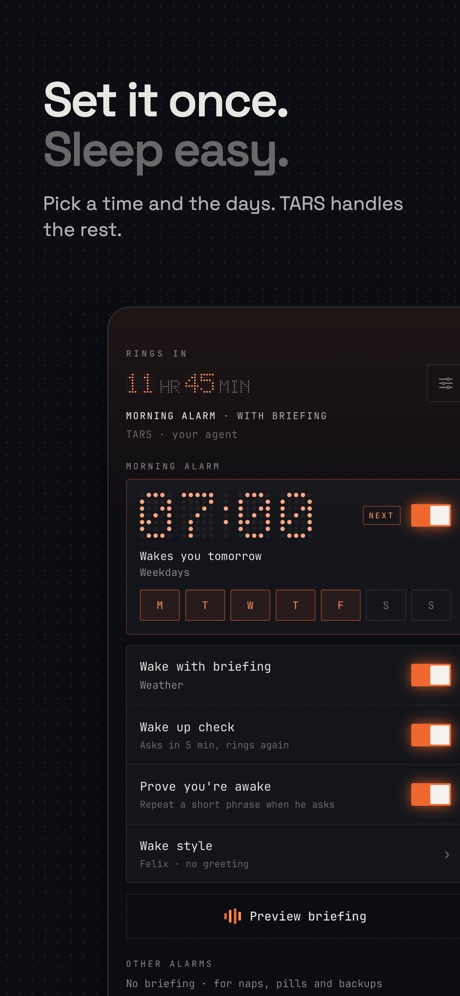
- It wakes you with a spoken question
- Rings on Silent and in Focus
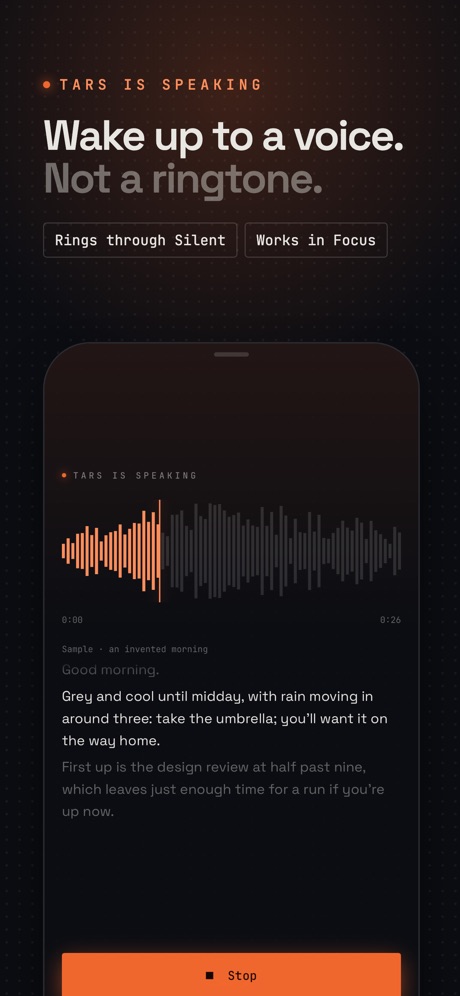
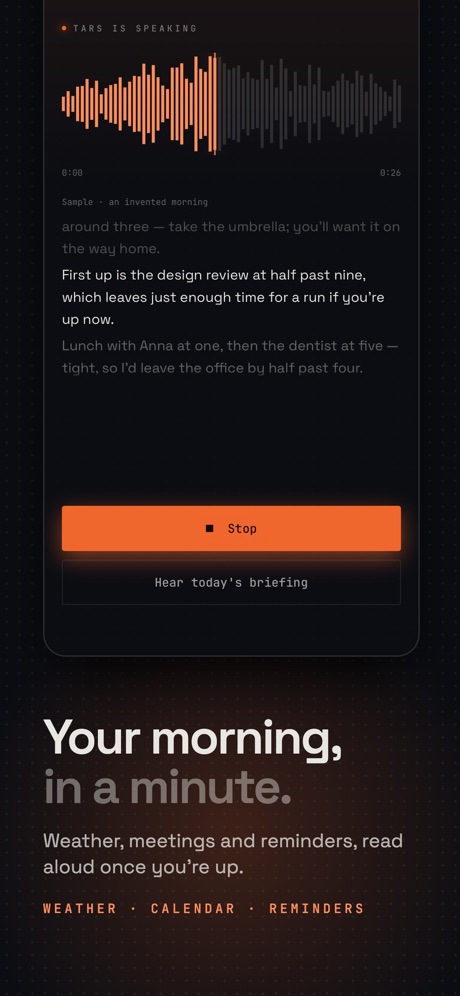
- Reads your weather and calendar aloud

 On a computer?
Scan with your iPhone.
Your night and morning
This is arithmetic. It counts back from the time you gave and knows nothing about your traffic. Your numbers stayed in this browser.
Updated · by the TARS team, I12Y LTD
How the calculator counts
It works backwards from the moment you have to be somewhere:
wake-up time = arrival time − spare time − trip − getting ready
lights out = wake-up time − hours of sleep
Example: you have to be at work at 8:30 am and like to be 5 minutes early. The trip takes 30 minutes and you need 45 minutes to get ready. You leave at 7:55 am, so you wake up at 7:10 am. For 8 hours of sleep, lights out at 11:10 pm.
Each cell in the strip is 15 minutes. On the result you can change every number and the strip redraws. Lights out means asleep, more or less, so add the minutes you usually need to drift off.
The four wake-up slots
- Off-hours noon to midnight
- An off-hours wake-up, so your night sits in the day or the evening. The arithmetic is the same.
- After the rush 8:00 am to 11:59 am
- A late start. Lucky you. The plan still counts back the same way.
- With the crowd 6:00 am to 7:59 am
- A classic morning slot. Nothing heroic, as long as lights-out really happens on time.
- Before the birds before 6:00 am
- Up before the birds. The price is an early night, so the lights-out time is the number to protect.
Why it does not count 90-minute cycles
Many bedtime calculators count back in 90-minute blocks, so that you wake at the end of a sleep cycle. The idea is neat and real nights are less tidy. The US National Heart, Lung, and Blood Institute describes it like this: "The cycle starts over every 80 to 100 minutes. Usually there are four to six cycles per night." With cycles that vary by 20 minutes, a clock cannot tell where yours will be at 6:45 am. So this calculator counts hours of sleep and leaves the cycles alone.
How many hours to plan for
The calculator takes the number you give it. For adults, the American Academy of Sleep Medicine and the Sleep Research Society advise 7 or more hours a night on a regular basis. If you pick less than 7, the result says so.
Your body clock matters too. A 5:30 am alarm is harder for a night owl than for an early bird. The chronotype quiz tells you which one you are, and the sleep quality test scores how well your nights work.
Making the alarm time stick
- Time your morning once, from feet on the floor to the door closing behind you, and use that number.
- Set one alarm for the time you really get up. Extra alarms before it only cut the last part of the night into pieces. The alarm calculator shows how many minutes.
- Keep the wake-up time on free days too. The AASM's healthy sleep habits put it first: "Get up at the same time every day, even on weekends or during vacations."
Questions people ask
What time should I wake up?
Take the time you have to be somewhere and subtract the trip and the time you need to get ready. To be at work at 8:30 am with a 30-minute trip and 45 minutes to get ready, wake up at 7:15 am.
How do I calculate my wake-up time?
Wake-up time = arrival time − spare time − trip − getting ready. Lights out = wake-up time − hours of sleep. The calculator does both and shows the result as a strip of your night and morning.
What time should I go to bed to wake up at 6 am?
For 8 hours of sleep, lights out at 10:00 pm. For 7 hours, 11:00 pm. Add the minutes you usually need to fall asleep.
Should I wake up at the end of a 90-minute sleep cycle?
Cycles are not a fixed 90 minutes. The US National Heart, Lung, and Blood Institute says a cycle starts over every 80 to 100 minutes, with four to six cycles a night, so counting 90-minute blocks from the clock is a guess. This calculator counts hours of sleep.
How much sleep should I plan for?
For adults, 7 or more hours a night on a regular basis. That is the advice of the American Academy of Sleep Medicine and the Sleep Research Society.
How long before I leave should I wake up?
As long as your morning takes. Time it once, from feet on the floor to the door closing behind you, and use that number in the calculator.
Sources
- National Heart, Lung, and Blood Institute, Sleep Phases and Stages. Length and number of sleep cycles.
- Watson N. F. and others, Recommended Amount of Sleep for a Healthy Adult: A Joint Consensus Statement of the American Academy of Sleep Medicine and Sleep Research Society. Journal of Clinical Sleep Medicine, 2015.
- American Academy of Sleep Medicine, Healthy Sleep Habits. Updated August 2020.